These are some notes put together, after attending the two day IRTF “Sustainability and the Internet” workshop in Passau, Germany, on learning that there was a IETF hackathon that had a focus on the provenance of energy readings. There will be a broader follow-up post about the IRTF event, but I am dashing this one out in a hurry, before I check out of my hotel room because I want to share some information that may be useful for the hackathon event taking place today. This may not make too much sense if you don’t have that context – sorry!
On July 18th there is a one-day IETF hackathon.
This deck presented by Marisol Palmero at the IRTF event may be of some use – it details some of the work that she and the working group within the IETF I’ve been doing to figure out a way to instrument networking hardware, to both record and expose energy consumption information readings, so that they can be passed around to other devices, and used for energy and carbon reporting.
The particular slide that caught my eye was the one I added below. In particular, there is something specific about creating a composite carbon intensity from power multiple sources, to end up at a single carbon intensity figure:
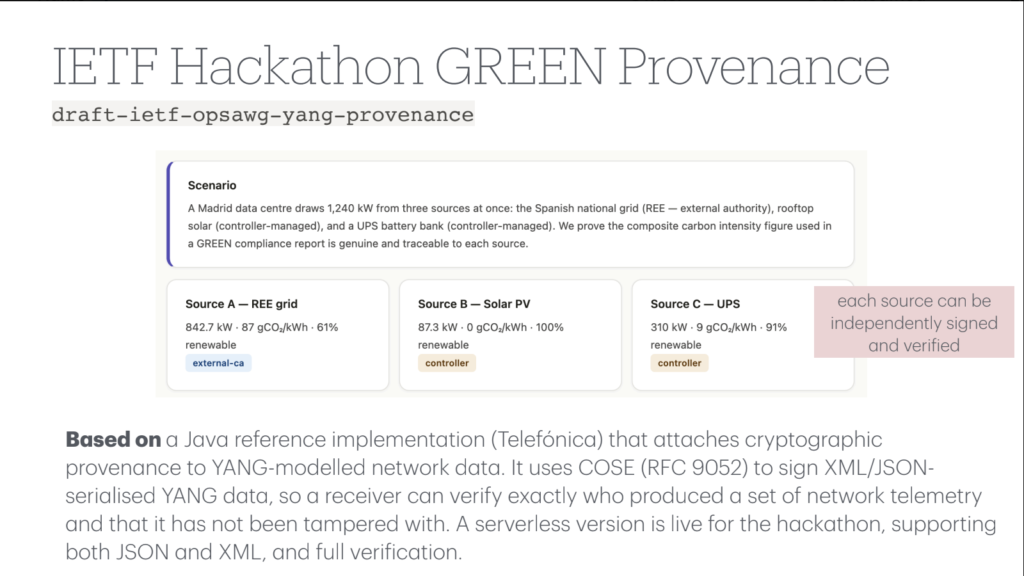
See those boxes with source A, B and C?
These are important.
Broadly, there is a shift towards more and more power going into datacentres that isn’t necessarily just from the grid – either from onsite generation, like solar panels, but also from batteries, that charge up from the grid when power is cleaner and cheaper, and then discharge when grid power is expensive and dirty, to provide cost savings and resiliency benefits. So it makes sense to reflect that.
However a lot of the time, even if power is coming from the grid, lots and lots of companies now have targets for using fossil free energy / clean / renewable energy, and having a mechanism to understand how power is being marked as such is important – particularly given that most large telecom operators now have commitments with the Science Based Targets Initiative that require this.
However, to do that, we need to understand how companies currently claim to use cleaner energy from the grid – the kind they buy with green tariffs and so on.
How clean energy from the grid is marked as clean
Right now the usual way to mark energy as ‘green’ or renewable when getting it from the grid is to match each megawatt hour of energy consumption with a certificate for a corresponding megawatt hour of generation from clean sources. In Europe this is called a G.O. – a guarantee of origin, but in other parts of the world they are referred to as EACs environmental attribute certificates.
Implicitly when you buy any kind of green energy tariff, this is what is happening under the hood, and it’s a legal requirement in Europe if you sell green energy to carry out this matching.
Previously, these certificates had an annual temporal resolution – that is, you could use one certificate to mark any corresponding megawatt hour of power consumption as green, even if you generated the energy during the day from solar and you used the energy at night in a datacentre.
This is problematic for all sorts of reasons, so in place of this, a new standard, called EnergyTag has been developed, based around the idea of creating a clearer link between matching power generation and power consumption.
Instead of an annual resolution, the focus is more on hourly resolution, and with a tigher link between where energy is generated and consumed, and except in a few cases, this needs to come from new clean energy, not existing solar farms, or wind turbines and so on.
This notion of hourly is now written into the new Science Based Targets Initiative (SBTI) corporate standard, if you use more than 10 GWh of energy per year. Many network operators are part of the SBTI, so this notion of hourly recognition is newly important.
Anyway, a key thing is that EnergyTag is an open standard, with clear documentation of how auditing works, but also with documentation about how claims of using clean energy should be backed by more granular hourly certificates. These certificates exist on a registry that is either maintained by a regulator or some entity acting on behalf of a regulator.
At a high level, certificates are now granular to the generating device, like a wind turbine or solar, as well as granular to the time generated – meaning it’s possible to establish a much clear link between the power generated and the power consumed.
However, this means that you can’t just buy a bunch of certificates for a year to count energy as clean and be done.
There are various companies now that will help you track and match power consumption following this standard. The best new resource is actually this new “about time” website, which has all kinds of information like suppliers, case studies, changes in law that have happened, and so on, all around the world.
What would I use for a hackathon though?
For a hackathon though, what is probably more useful is knowing that there is an open API spec that demonstrates the API calls you might make to say:
I have used X quantity of energy at time Y. Please fetch me a bundle of certificates that would correspond to this energy consumption so that I have “coverage” from clean sources.
The actual API is listed below – showing the requests you might make – My understanding is that any registry essentially implements this API under the hood:
What may be useful to know is that there is a also an open source reference implementation of a project that exposes an API like this. So while different regulators or different countries might have their own versions of a registry, this is your handy open source equivalent to see how it all works internally:
https://github.com/Future-Energy-Associates/granular_certificate_registry
What could you do with this in the context of this YANG provenance stuff?
I think one thing that may be possible here, for the purposes of a hackathon, is allow very granular matching of energy consumption with clean generation, providing a very clear provenance of where the power came from, for power you source from the grid. It may be that you do not want to do this at a device level, but my understanding of YANG is that you can do aggregations of energy consumption upwards where there would be enough energy consumption at a given point in time that would make sense to match with a corresponding bundle of certificates.
This matching used to be something that was manually handled by sustainability offices and energy buyers once a year, but if you have an API it might make sense to have the matching of consumption and generation be something that is just built into the systems themselves, to give a more real time signal of how much energy is being matched and from what sources.
If you have specific targets of clean energy matching that you want to maintain, because you have an explicit target of the energy you want to demonstrate matching with clean generation, this is one way that you can actually have a system respond accordingly.
Other helpful links
Anyway, I’ll add a few more links below that may be of interest.
Marisol’s initial sketch on github: https://github.com/marisolpalmero/green-provenance
The recent extension of the YANG model to track power and energy: https://www.ietf.org/archive/id/draft-ietf-green-power-and-energy-yang-03.html
Where I work at the Green Web Foundation, our post about switching to align around these newer criteria: https://www.thegreenwebfoundation.org/news/request-for-comment-updates-to-our-verification-criteria-for-data-centers-and-hosting-providers/
Technical guidance from the 24/7 coalition who are also aligned around the EnergyTag spec now – https://www.theclimategroup.org/247-technical-guidance
The main docs for the energy tag standard and API: https://energytag.org/resources/?category=Standards