It’s a Sunday and I finally have a chance to catch up on some reading – mainly reducing the number of angry red dots in NetNewsWire (yes, I still use RSS), and tabs in Vivaldi. One thing that caught my eye though was learning about a recent Atlantic crossing in a electric-hybrid aircraft for the first time. I didn’t know this was a thing yet, so I’m sharing some notes to come back to in future.
The link from the Simplifying blog / newsletter / podcast thing is here – In industry-first, GE Aerospace flies hybrid-electric aircraft above 30,000 feet — and across the Atlantic.
Why is this interesting?
One of the reasons is that as someone who has tried to avoid unnecessary flying, but still ended up catching planes over the last few years to see family, or go on family trips, I’m aware that this is likely one of the most harmful things I can do from a climate perspective.
There are steps I can take to reduce flying, but I’m also mindful that I won’t be able to get rid of it entirely – I live on a different landmass to my direct family in the UK, I’m married to a woman from California, and I have family in Australia, and from a selfish perspective, I find the experiences from international travel to be one of the more profound, enriching aspects of life.
So if it can’t be cut out of my life, I guess I can at least educate myself about the subject, how it can be made less harmful, and to the extent that is realistic for a person in my situation, what I can do about it.
I’ll write a little more about my specific quantitative approach another day, but for now, the thing I find interesting about this story is that it changed some assumptions for how I see the options for cleaner, greener flying.
A few key things from this story
So the general gist for this story is that for the first time ever, people flew an electric-hybrid plane from New York, to the UK, to demonstrate that it was possible, but also to better understand how electric aviation options change the nature of flying.
Smaller hops – not a single long flight
They didn’t fly directly from say… Newark Airport in a single flight to the Heathrow.
Instead, it was a series of hops from New York USA, to Canada, then to Greenland, then Iceland, then Scotland, and finally the south of England. When I looked up the distances and speeds of the plane, I think it would have been about 2-3 hours per hop, not counting time on the ground between flights.
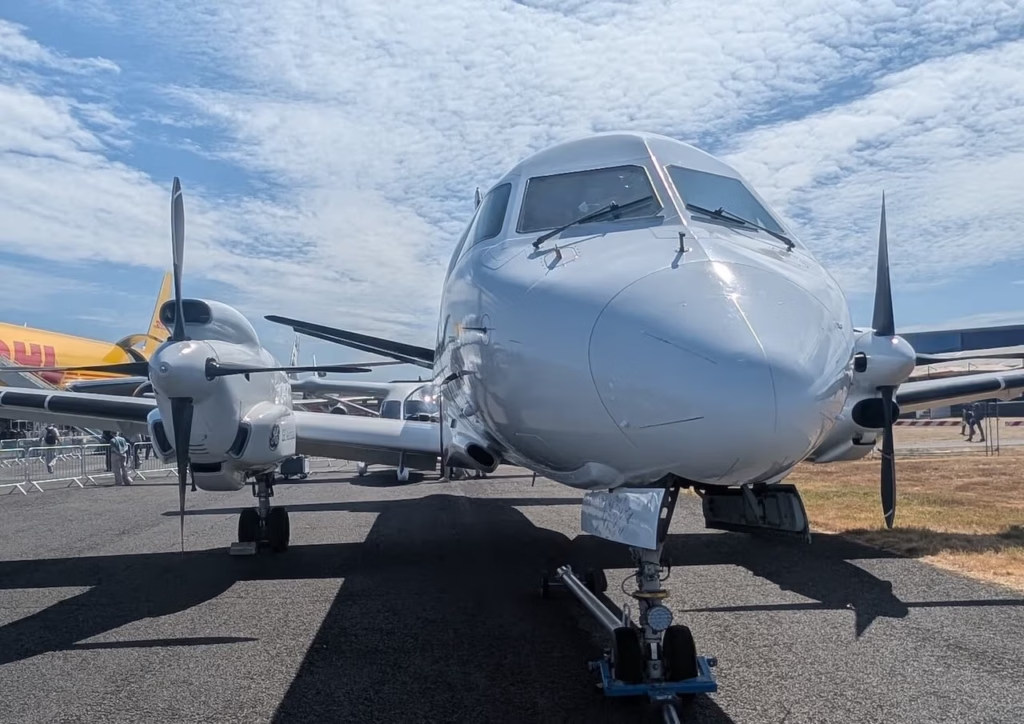
This makes sense, since the plane in question was a Saab 340B turboprop, with lower range than a long distance airliner. It had one special electric-hybrid engine, which was the reason for the whole exercise.
Here’s an image from the article – on the left of the plane (i.e. its right hand side engine), you can see an inverted engine with the air intake on the top, and the electric motors added beneath the propellors. If you compare it to engine nascelle on the opposite side, you’ll see a regular engine, with the air intake below the propeller, which is the default configuration.
Electric might change how energy gets used during a flight.
How did flying with a hybrid change things? Here’s an interesting quote:
During the Atlantic crossing, the hybrid boost allowed the crew to reach a safer altitude faster and cruise higher, where drag and fuel burn are lower; the electric powertrain, unlike a gas turbine, is indifferent to thin air. On descent, the system regenerated power back into the batteries.
The flight itself went off without drama, according to Christine Andrews, GE Aerospace’s hybrid electric systems leader. “The system operated exactly how we thought it was going to at 30,000 feet,” she said, calling it the smoothest test campaign, in the lab, on the ground and in flight, she has been part of.
This quote got me reading about the physics of aviation, because I didn’t understand a few things mentioned in it, so I’ll try unpacking them here – I think others might not know about it either, and a bunch was interesting to me.
Why fly high in the first place?
The first bit was about flying higher in the first place – if you can get a plane to altitudes where the air is thin and drag is low, you go further on the same amount of energy, or if you prefer, the same distance with less energy. This is why airlines fly high – it saves fuel once you’re up there, because you don’t need to burn so much fuel to cover the same distance.
It’s energetically expensive to get that high though in the first place, and if you want to climb high into the sky quickly, to get to the sweet spot, you need big engines to climb fast. Once you’re high up you don’t need such a big engine, because as mentioned before, you’re using less energy to cut through thin air. But because the big engines are heavy, now you’re carrying all that extra weight of that engine, even though you’re now using only a fraction of the power it has available. This is the first place electric motors help.
Electric motors – light weight, lots of power, but don’t expect lots of range in planes
This is the first place electric motors are helpful. Electric motors can provide close to maximum power pretty much from the get go – which is why you see such wild acceleration figures for EVs, even if they’re heavy. However EVs are typically heavy because of the battery, not the motor, which is almost always smaller than comparable internal combustion engine of similar power output. You could still have an really fast EV with small motors and small battery and still get the benefit of massive power leading to otherworldly acceleration, but your EV would not have much range.
So where does this fit in with aviation? Well, the power is still useful, but relatively speaking, you can’t store much energy in a battery. So if you only had batteries, you’d need lots of batteries, and because all these batteries are heavy, you end up with a heavy plane, that needs more energy to fly, which needs more batteries, and so on.
So long flights are not plausible with batteries – the energy you can store in the batteries we have commercially available is too small. By comparison, chemical storage in the form of fuels like kerosene and the like store waaay more energy – something along the lines of 30-40x more energy for the same weight, meaning you can travel 30-40x further for the same weight.
Electric aviation hybrids and the misleading mental models
So, this implies hybrid planes that use electric motors to help with take off, but save on weight by having only enough batteries to supplement the power from a regular combustion engine for short periods where you need all this extra power. You might pair that with a smaller combustion engine for cruising, that doesn’t need to be so powerful, because it’ll primarily be consuming energy dense chemical fuel at a cruising speed, rather than having to do all the work of getting high into the sky by itself.
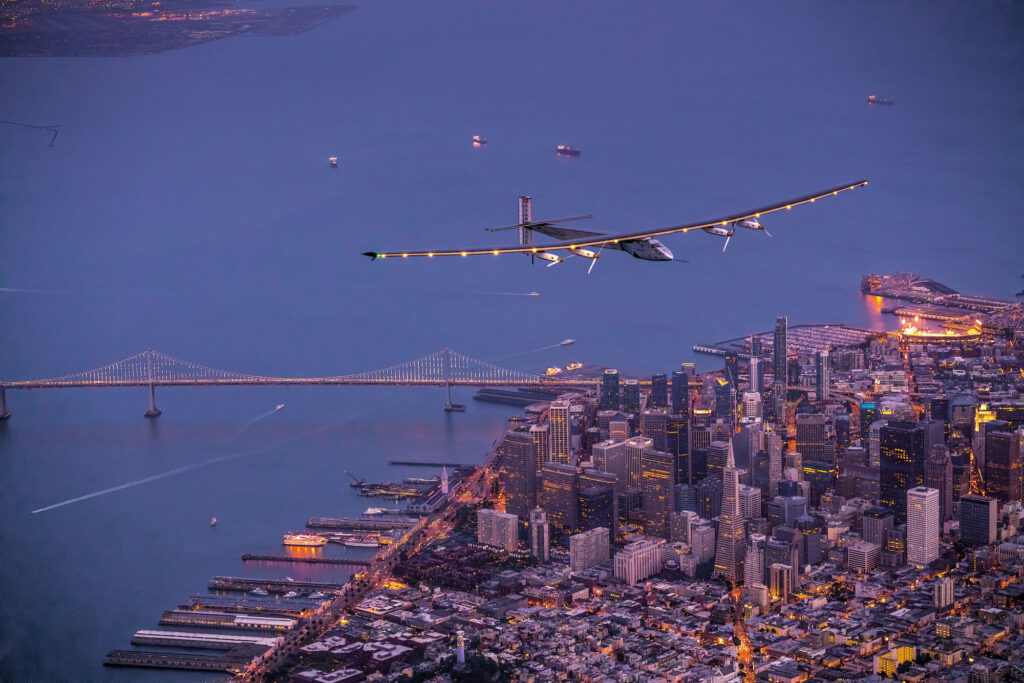
This is the opposite mental model I had – before I thought this through, I had assumed a hybrid would have some kind of battery sipping electric motor in use at high altitudes like Bertrand Piccard’s Solar Impulse plane, but for take off / landing, you’d still be relying on the BIG LOUD BEEFY COMBUSTION ENGINES for all the extra power you need.
I think this is because almost all my life, I’ve been taught to associate internal combustion engines, like big roaring V8 car engines, with massive power. But that’s down to my mental model being out of date – things have clearly moved on.
I’ve included a picture of the Solar Impulse plane below, and you should just about be able to make out solar panels all along the wings, which helped top up the energy as it flew. You totally can use smallish electric motors for electric-only powered flight, but they can also be surprisingly powerful for their size.
Is this it? Do things end at hybrids?
Back to this hybrid thing though – this is not ideal long term, because combusting fuel is still the driver of carbon pollution in this scenario.
Are we stuck with it?
Well, one of the big hopes is SAF (Sustainable Aviation Fuel), which is usually some form of kerosene or other chemical fuel made from non-fossil sources. Here the idea is that if the fuel is already biogenic i.e. from biological sources already in circulation in the carbon cycle, then the carbon emitted will be drawn down by trees or other carbon absorbing processes, and keep circulating, rather than being a net increase in CO2 in the atmosphere. As I understand it, the emissions reductions are not total – you see claims of between 50 to 80-ish percent savings versus using fossil fuels.
The other is hydrogen – and in the interests of space, I’m just going to say it’s considered quite a bit further off – maybe we’ll see planes using hydrogen in the 2040’s.
Let’s come back to batteries though, because my example above might have sounded a bit pessimistic.
Would you ever see battery-only planes?
If you had battery-only planes, you’d essentially get rid of all combustion, which would be fantastic, but you’d need much higher battery energy density to replace much of the aviation we think of, when we talk about consumer aviation and flying for holidays.
How much more? We can put some numbers on this.
Right now, in high performance EVs, you might see something like an energy density of 200-250Wh /kg in their batteries, which is enough to give sub-3 second acceleration times in EV cars. Even in ones that are actually quite heavy, like the recent Ferrari Luce can do this, because the electric motors are so powerful.
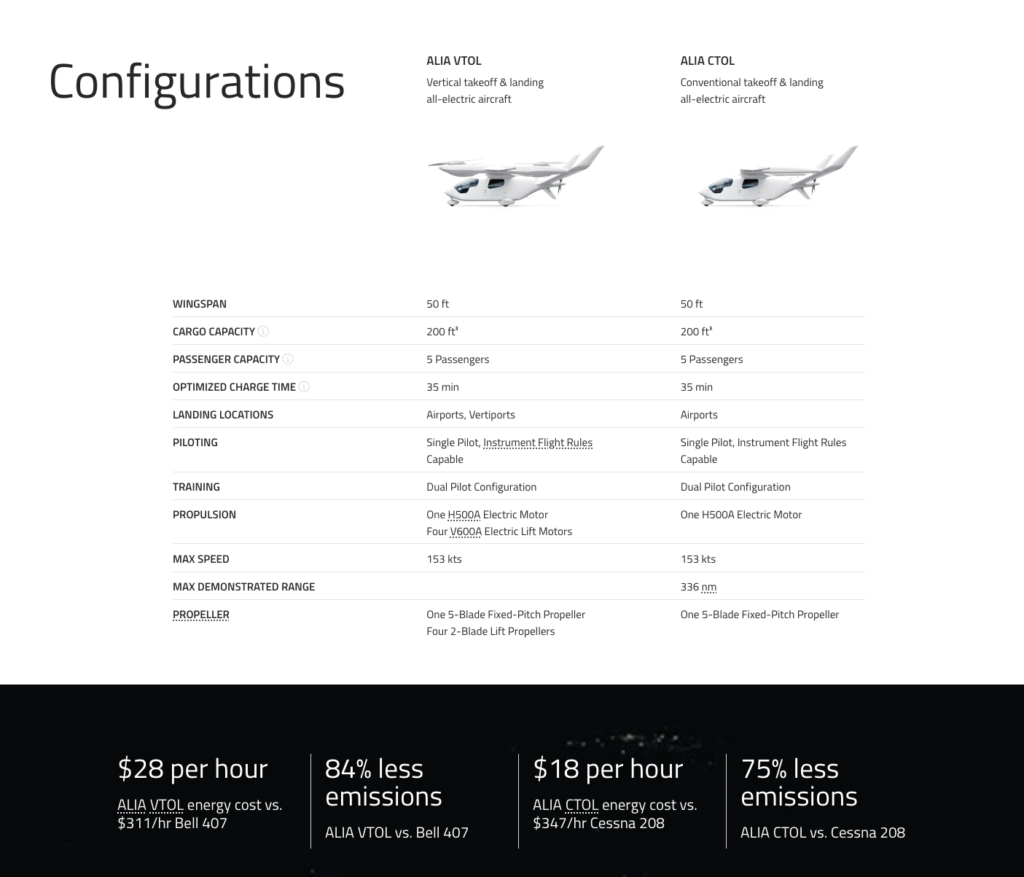
There are also examples of electric planes that use batteries like this. One example is the BETA Technologies Alia CTOL plane, an electric plane whose batteries are estimated to have energy density in the same ballpark, at around ~170 wh / kg, allowing 6 people to travel with ~330 nautical miles / ~620km of range. For context, flying from London to Berlin is between 500-550 nautical miles / 900-1000 km, depending on which airports are used. If you were elsewhere in the world, flying from Taipei to Okinawa, you’d be flying between 400-450 nautical miles, or maybe 650 to 750km.
However, batteries keep getting better.
In June this year, CATL, the largest battery manufacturer in China, announced a whole new research direction for lithium air batteries, publicly stating they think they can achieve 12,000wh / kg. This is mind blowing – it’s comparable to chemical fuels like kerosene now. The article linked above states that they’re already at 1200 wh/kg in the labs, which is already 5-6x what we consider ‘good’ in EVs. It’s actually more than the 6x the official figure stated by BETA Technologies for their Alia aircraft.
What would that do to range?
A 6x energy density improvement like the prototypes mentioned now, at 1200 wh/kg might mean that same Beta Alia plane ends up with 6x the range, taking it to around 1980 nautical miles, and more than 3600km.
In practice, I suspect you’d want to carry more people instead. For context, 1980 nautical miles would actually be more than double the range of that Saab 340B pictured above, which typically has a range of closer to 900 nautical miles when burning fuel.
What about that headline grabbing 12,000wh/kg figure? That would be ten times more again – 19,800 nautical miles, or 36,000km. That properly feels like science fiction stuff, because flying from London to Tokyo is about 6000 nautical miles – well inside that monster range.
Let’s be honest though – you’d probably want to travel faster, which would use up more of the range.
What would that do to the costs of aviation?
Anyway, the other thing to bear in mind is that with aviation at present, the cost of fuel is a huge factor – when you’re buying a plane ticket, fuel makes up a huge share of those costs.
The other promise of electric aviation is that electricity is considered cheaper than fuel, and to give some numbers. Beta Industries claim north of a 90% saving on energy costs per flight hour with electricity, compared to using fuel in a comparable plane.
Here’s the screenshot from Beta Industries aircraft page, where they explicitly state it:
Wrapping up
When I read about all this, I honestly feel quite hopeful about the technical barriers to clean aviation being addressed over the medium term – it feels like that, just like with EVs on the road, electrification means you end up with a better, cleaner, product, which doesn’t emit at the point of use. The examples above represent an aggressive improvement in energy density, but hopefully you should get an idea of the direction of travel at least.
The economic barriers are another story – for conventional aviation, airframes last for 10-20 years. So big fossil fuel burning planes bought today are expected to keep burning fossil fuels, or in the very least, SAF for another 20 years.
In Europe and the UK, there actually are mandates that require a growing share of SAF to be blended into jet fuel – with 6% required in Europe by 2030, and 9.5 in the UK. This will likely reduce the carbon pollution slightly, but also push up the cost of fossil aviation too over time.
In a future post, I’ll write a little about the action I’m taking, beyond reading up on the topic.
Til then, hope this was interesting. If you ever want to discuss this with me, check my about page for how to get in touch.
Comments
58 responses to “Sunday reading notes about electric aviation”