As part of my day job, I end up thinking a lot about the decarbonisation of the digital sector. Recently we have seen laws proposed to prioritise building a bunch of massive datacentres in Europe ahead of actually following the science and taking the steps to clean up the economy. Some information has become available that now makes me think the reasoning is even flimsier than I thought. I’m writing this post as sense check though, so if this is in your domain of expertise, I’d love to hear from you.
First of all, some context – Europe, the AI Continent Action Plan, and tripling datacentre capacity in 5-7 years
In Europe, there is an ongoing public discussion about how the continent can keep up in global race to stay competitive with the other two next largest economic blocs: the US, and China. Against this background, we’ve seen the European Commission propose the AI Continent Action Plan, part of a multi year strategy to help Europe regain its perceived competitiveness, and close the technological lead the others have over it.
Now there are various strategies you could choose for this, and there’s a helpful page that lists the key ones
- setting up at least 19 AI factories across Europe, using our world-leading supercomputing network. These factories will support startups, industry, and researchers to develop cutting-edge AI models and applications
- establishing up to 5 AI gigafactories, large-scale facilities with massive computing power and data centres. They will enable the training of complex AI models at an unprecedented scale. This initiative requires both public and private investment and will secure EU leadership in frontier AI
- the InvestAI facility that aims to mobilise €20 billion, to drive private investment in gigafactories
- proposing the cloud and AI development act that will boost private investment in cloud and data centres. The goal is to at least triple the EU’s data centre capacity within the next five to seven years, prioritising sustainable data centres.
The one I want to talk about here is the one at the bottom – at least triple the EU’s data centre capacity within the next five to seven years, prioritising sustainable data centres.
Where did this triple capacity idea come from?
Tripling datacentre capacity in Europe would be a significant undertaking, particularly in such a short timeframe. Because datacentres are incredibly expensive, particularly AI datacentres, it would likely mean diverting time and attention, and funding from other priorities any government has, so you’d expect there to be some kind of evidence base to justify such a drastic decision.
When laws like the Cloud and AI Development Act (the legal instrument to bring about this tripling of capacity) are proposed, part of the process involves some kind of impact assessment to understand what the implications might be, and to help justify some of the decisions. And sure enough, although it took a while, we have one such document now in the public domain, carried out by the consultancy Technopolis – Study on the EU’s critical digital capacities deployment beyond 2027 – Final Report. If you look, it does share a bit more information about this tripling figure.
Artificial Intelligence: Despite accelerating adoption, several barriers continue to hinder AI deployment across the EU-27. A major constraint lies in the limited availability of AI-optimised hardware, such as AI chips, and a growing gap in data centres and cloud infrastructure. To meet demand, Europe’s data centre capacity needs to triple by 2027, reaching approximately 22,700 MW [181].
So we now have a figure that is oddly specific – European datacentre capacity needs to triple, to 22,700 MW, and it needs to do so by 2027. The 181 is a referenced footnote we can follow later in this post.
Now this is a document being used to justify tens, if not hundreds of billions in public money being spent, and because Europe doesn’t have many of its own chipmakers, when you’re talking about building gigawatts worth of datacentre capacity, it represents a massive flow of public funds out of Europe to other countries. So you’d expect the argumentation to be pretty convincing, right?
Let’s listen to the estate agent selling datacentres for guidance on how much we should spend on datacentres
The reference turns out to be a blog post from Savills, a commercial real estate firm, who have a business helping people invest in datacentres. The more people invest in datacentre real estate, the more money they make, so straight away they’re incentivised to inflate demand. Let’s look at the quote from the linked post:
Scott Newcombe, EMEA Head of Data Centres at Savills, comments: “Despite the high number of new data centres anticipated to be built by 2027, the market is expected to remain largely undersupplied across Europe. Given the projected expansion of internet bandwidth usage, European data centre capacity needs to triple by 2027 and reach around 22,700 MW in power so there remains a significant supply/demand gap.
OK, so now we have the source of the 22,700 MW figure, and we have some reasoning shared – internet bandwidth usage is growing, so therefore datacentre capacity needs to triple too.
Before we pounce on this quote out of context, let’s remember that this is just a quote from a blog post that is effectively a press release for a report published by Savills called European Data Centres Navigating the new data-centric frontiers.

So, maybe there’s something more rigorous in the report to back this up, because remember, this is a massive amount of public money to spend, and represents a real change of priorities from a few years back.
Two mentions of tripling – is that it?
Right in the opening key points you see this – datacentre capacity is growing, but total internet bandwidth usage is almost tripling in the same period of time. Here’s the snippet of the report:

This seems to be presented as significant, like these ought to be rising together, and right now things are totally out of balance. Maybe there’s more later in the report – let’s have a look. Here’s the screenshot for context:
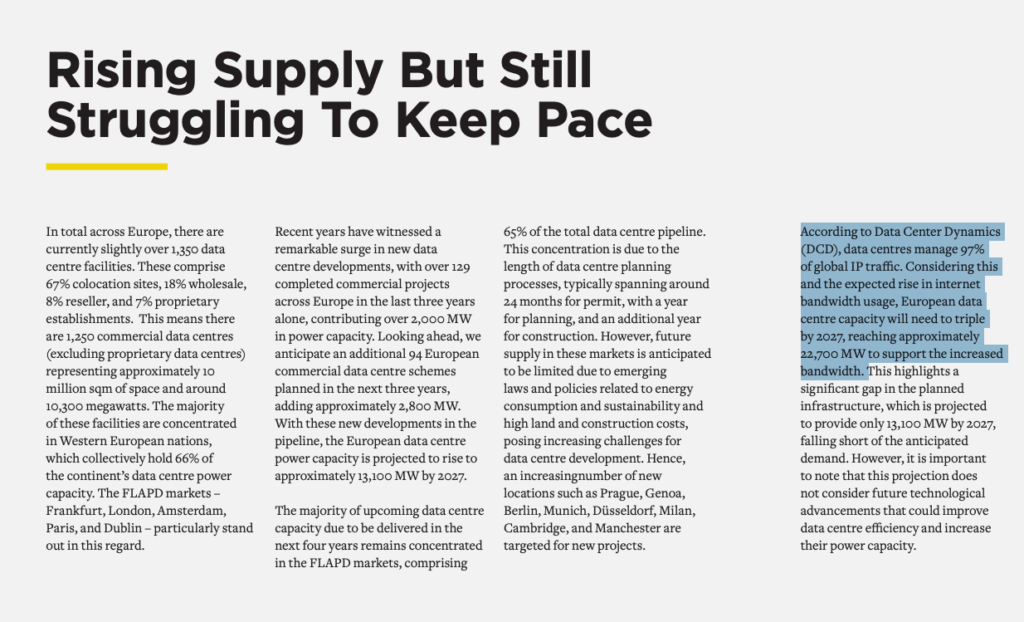
The text is small, so let’s see what it says, because this is pretty much the entire argument used for tripling capacity:
According to Data Center Dynamics (DCD), data centres manage 97% of global IP traffic. Considering this and the expected rise in internet bandwidth usage, European data centre capacity will need to triple by 2027, reaching approximately 22,700 MW to support the increased bandwidth. This highlights a significant gap in the planned infrastructure, which is projected to provide only 13,100 MW by 2027, falling short of the anticipated demand.
Right. So the argument everything is being based on is basically because people are sending three times as much data over the internet, we need to triple the datacentre capacity.
There’s no further explanation. It’s presented like it’s some self evident, natural law.
Intuitively it might feel right as well – if one thing grows, you’d want the other to balance out too, surely?
The problem with this
Right away, there are a few problems with this.
First of all, comparing data transfer (bits you send over the internet) to datacentre capacity (how much total power all the servers in datacentre are able to draw at once) like this makes no sense – they’re totally different things. It makes about as much sense as saying that the number of fans in a server needs to triple if network transfer triples.
Secondly, for this to be used as the basis for policy feels, really, really irresponsible. Under what circumstances would you ever ask a company selling real estate if you should be buying more real estate, and expect them to say “Nah, I’m good.“?
Thirdly, we have already seen years of growth in both data transfer and network capacity, and in datacentre capacity, and these definitely have not been growing on a 1:1 basis. Speak to a network engineer and they’ll tell you that datacentre capacity and bandwidth usage don’t scale on a one to one basis. To say they do is basically disregarding literally decades of data.
So there might be no link between these two things. Who cares?
Now I’m not saying that the entire premise of a continent’s AI strategy is totally flawed if one reference is a bit suspect, but this triple datacentre capacity goal is being used to justify some terrible decisions.
From decarbonisation to recarbonisation
Here’s the most recent example I can think of. This AI goal is being used as the pretext to not only build a massive amount of datacentres, with almost no evidence that they’re needed, but it’s also being used to power them all with on-premise gas generators, instead of connecting to the grid. See this recent story quoting Lex Coors, of the European Data Centre Association, taking the mask right off:

It’s not just this report though.
At the time of the original Savill’s report being published, you can see a few other industry publications picking up the same claims. Here’s one – Datacentre me warming over the same blog post, and here’s another from Datacentre Network News. You can also see McKinsey jumping on this bandwagon, but tweaking the units a bit so it’s not so obvious they’re drawing directly from the same report.
Is this really as flimsy as it sounds? Surely the triple datacentre capacity goal can’t be *this* stupid.
I’m not going to pretend I don’t have opinions here, and I also have not designed a datacentre facility myself, so there might be things I’m missing.
But I’m also not clueless.
A good few links for this post came from research I was carrying out while prepping for a talk I gave today at the TMA Network Traffic Measurement and Analysis Conference in TU Delft, and more specifically, their side event, Measuring and Reducing Carbon Emissions in End-to-End Networked Systems.
I’ve spent a decent amount of time researching this field, and this feels like an incredibly flimsy basis for such large policy decision, particularly when you see it being instrumentalised like this.
I mean, the irony is that this is precisely the kind of question you could trivially sense check by typing a prompt into an LLM like Claude or ChatGPT to see if there was something up. You can try it for free now:
If network transfer in Europe increases threefold, does this mean datacentre capacity should increase threefold too? Walk me through the answer, and your reasoning.
Really, this feels so much like the stuff Jon Koomey used to write about in the early 2010’s, about how people used predictions of the internet in the early 2000’s to justify huge investments in new coal fired power generation. If you’re not familiar with this writing about it, I really, really recommend it for understanding this moment.
In case I missed something obvious
Anyway, I wrote this post to speed along discussions I might have with domain experts to help me see if I’m missing anything obvious.
If you’re reading this, and you feel like you have enough context to either point out something that makes this triple data centre capacity claim make more sense, I’d love to hear it.
Conversely, if this really is bullshit, I’d appreciate the sense check, because it’s much easier to speak to policy makers about how irresponsible and flawed this all is, when you have a few respected voices saying essentially the same thing.
Update:
I’ve now been to two events organised by and attended by people who are domain experts – professors of energy systems, networking, datacentre operations, and so on. I would trust the opinions of these people much more than estate agents whose job it is to sell datacentre real estate when asking about demand and capacity planning.
One was in Delft, the Netherlands at the Network Traffic Measurement and Analysis Conference Side Event: Measuring and Reducing Carbon Emissions in End-to-End Networked Systems. You can see my deck that I used to ask these questions when I was presenting there.
The other was at the Internet Research Task Force workshop on Sustainability and the Internet in Passau, Germany. You can see my deck for that event too, when I was presenting, and ended up touching on the same topic.
Without putting too many words in the mouths of people I have spoken to so far, the consensus is leaning much more towards bullshit than not at this rate.
This is not to say there will be no growth in demand, or that we will use technology less – it’s that coming up with a number like tripling datacentre capacity like this, with such flimsy supporting evidence basis seems incredibly irresponsible. We have been here before, when the internet was relatively new to the mainstream, just like what we might refer to broadly as AI is relatively new to the mainstream today, and there are lessons learned that we can apply today.
Comments
66 responses to “Is this *really* a good reason to triple datacentre capacity in Europe?”